
DM Arms revolver by YNG
Owner'sManual
How to handle, load, fire and look after the revolver rifle. Read it through before the first shot, and keep the file with the firearm.
- Pages
- 13
- Chapters
- 08
- File
- PDF · 3.98 MB
WarningRead the instructions and warnings in this manual carefully before using this firearm.
Gun safety rules
Observe these rules of safe gun handling.
- 01
Always keep the muzzle pointed in a safe direction. Watch the muzzle at all times: never point a gun, accidentally or intentionally, at any person or anything you do not intend to shoot. Identify the target before shooting; do not shoot at sounds.
- 02
Always treat a gun as if it is loaded — it may be.
- 03
Keep your finger off the trigger while operating the action, and at all other times, until you are ready to shoot.
- 04
Keep the safety “on” or in the “safe” position at all times until you are ready to fire. Do not rely on your gun's safety: the safety on any gun is a mechanical device and is not a substitute for common sense or safe gun handling.
- 05
Learn how your gun functions and handles. If you do not thoroughly understand the proper use and care of your gun, seek the advice of someone who is knowledgeable.
- 06
Do not alter or modify any part of the firearm.
- 07
Store guns unloaded, separate from any ammunition, and out of the reach of children.
- 08
Be sure the barrel is clear of any obstructions before loading. Make it a habit to check the barrel every time before loading.
- 09
Be sure you have, and use, the proper ammunition.
- 10
Wear protective shooting glasses and adequate ear protection when shooting.
- 11
Never climb or jump over anything — a tree, a fence or a ditch — with a loaded gun. Open the gun, remove the ammunition and hand the gun to someone else, or place it on the ground on the other side of the obstacle, before crossing yourself. Do not lean a gun against a tree or other object; it could fall and discharge.
- 12
Do not shoot at a hard surface or at water. Bullet and shot can ricochet and travel in unpredictable directions with great velocity.
- 13
Never transport a loaded gun, and never place a loaded gun in a vehicle. When not in use, the gun should be unloaded and kept in a case.
- 14
Never drink alcoholic beverages before or during shooting.
Parts of the rifle
The names this manual uses for each part. Point at a name to find it on the rifle.
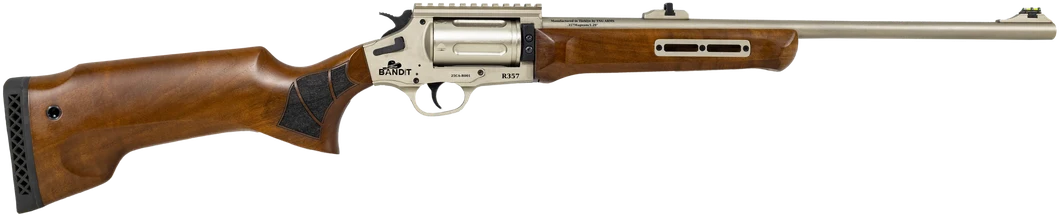
- 01Stock
- 02Hammer
- 03Cylinder
- 04Trigger
- 05Receiver
- 06Forearm
- 07Adjustable sight
- 08Barrel
- 09Fibre blade sight
Revolver operation
The revolver has a cylinder with five chambers, turning around a central axis, which lets you fire five shots. The number of chambers can be reduced to three with the wedges supplied with the revolver rifle.
When the cylinder is locked in position the firearm is ready to fire. Shots may be fired single action — cocking the hammer, then pulling the trigger — or double action, by pulling the trigger alone. Either way the cylinder advances, aligning each chamber with the barrel in turn.
General safety rules
- 01Always keep your revolver unloaded after shooting.
- 02Be careful not to squeeze the trigger while the revolver is empty.
- 03Never point the revolver at people or dwellings while loading, and do not attempt to load in closed areas.
- 04Never leave a loaded revolver unattended.
- 05Do not forget to unload the rifle if you decide not to shoot.
Loading and unloading
Loading the cylinder
Point the barrel in a safe direction. With the thumb of the right hand on the left side of the receiver, push the thumb piece forward and at the same time press the cylinder, swinging it out to the left (Fig. 1). Holding the gun with the muzzle pointing downward and the cylinder at its outermost position, insert the cartridges (Fig. 2). Once loaded, close the cylinder gently but firmly into the frame until it latches, then check that it is locked.
Unloading the cylinder
Open the cylinder as for loading, but with the barrel pointed upward. Eject the cases by pressing sharply on the extractor rod (Fig. 3) and make sure every fired case has come out; the cylinder is then ready to reload. Spent cases are hot and may have sharp edges — take care when removing them.
Before loading
- Danger
Always make sure the muzzle is pointed in a safe direction.
- Safety first
Never load or unload any firearm inside a vehicle, a building or another confined space, except a properly constructed shooting range. Enclosed areas rarely offer a completely safe direction to point the firearm; an accidental discharge there carries a great risk of injury or damage.
- Safety first
Before loading, clean all grease and oil from the bore and chamber, and check that nothing obstructs the barrel. Any foreign matter in the barrel could bulge or burst it, damage the firearm and seriously injure the shooter or others.
Wedge assembly
Should the need arise, the revolver rifle can be used with three rounds by reducing the cylinder's capacity. Use the wedge kit (Fig. 4) and follow the steps below to insert and remove the wedges.
Fig. 5Push the wedge completely into the chamber using the wedge balancer. Fig. 6Set the wedge screw on the wedge with the Allen wrench, from the rear of the cylinder. Fig. 7To remove it, hold the wedge with the wedge balancer and unscrew it with the Allen wrench. Fig. 8Gas deflector: place the gas deflector in front of the cylinder and tighten it with its two screws.
Firing
- Danger
Keep the muzzle pointed in a safe direction and your finger away from the trigger when cocking any firearm.
- Warning
Never carry, handle or leave unattended a firearm that is cocked and ready to fire. Cocked, it will fire from slight pressure on the trigger; an accidental discharge could easily follow if you fall or drop it, or if it is struck or disturbed.
- Warning
Never fire with your finger, hand, face or any other part of your body over or beside the gap between the cylinder face and the forcing cone. Hot gases and particles escape there as part of normal operation; they pose no hazard when the firearm is held in a normal grip and fired as designed.
- Caution
Never let anyone stand beside you where ejected particles or gases could strike them. They are hot, and can burn, cut or injure an unprotected eye. Keep the path for their safe ejection clear.
- Danger
If the firearm develops any mechanical malfunction or binding, “spits” powder or gas from the muzzle, punctures a primer, bulges or ruptures a case, or does not sound quite right on firing: stop shooting immediately. Unload the firearm — do not try “one more shot” — and take the firearm and ammunition to a gunsmith for examination.
- Safety first
A case may occasionally jam against the breech face and stop the cylinder turning. Keeping the muzzle pointed in a safe direction and your fingers well clear of the trigger, push the cylinder release and try to open the cylinder. If it swings open, eject all ammunition and spent cases, then inspect the ammunition and the breech before shooting again. Do not reuse ejected ammunition.
Care and maintenance
- A
Under normal conditions the gun can be cleaned and lubricated without any disassembly.
- B
Where disassembly is needed, as for repairs, return the gun to the factory or send it to a competent gunsmith or the importer.
- C
To keep the gun in perfect condition, keep it clean and covered with a slight film of good-quality oil against corrosion — above all after use.
- D
For a gun not in use or kept in storage, rub it with a lightly oiled cloth, and the bore of the barrel the same way. Wipe off the excess oil but leave a thin protective film, and brush the dust from every crevice with a small, clean brush.
- E
The revolver's design calls for frequent, thorough cleaning. Watch the forward face of the cylinder, where residue can build up and make the cylinder bind or drag. After shooting, remove all powder residue from the barrel and the areas around it with a suitable brush. Lead or plastic debris in the barrel is scrubbed out with a brass brush soaked evenly in oil, inside the barrel and where it joins the frame; then lubricate as above. After more than 100 rounds in a row, repeat this cleaning before shooting further.
- F
Plastic deposits build up at the choke constriction over time. Any commercial plastic solvent made for this is suitable; follow its maker's instructions carefully.
- G
Keep the firearm away from materials that attract moisture or are acidic, and from places with large swings in temperature or humidity.
- H
If the firearm is to be stored for a long time, take particular care to protect its metal surfaces against corrosion.
Service agreement and limited warranty
- Parts and service
- 1 year
- Free parts
- +1 year
- Registration
- 30 days
YNG agrees to service its products free of charge for defects in materials and workmanship, in accordance with this service agreement. YNG's obligation is limited to the repair or replacement of unserviceable parts and does not cover incidental or consequential damages. Other than the express warranty contained herein, YNG makes no warranties, express or implied.
YNG will repair or replace any unserviceable part for one (1) year from the date of purchase, and will supply free parts (wood not included) for one (1) further year, provided the firearm has not been altered, abused, wilfully damaged or damaged by overpressure ammunition. This agreement is not transferable; its benefits apply only to the original purchaser.
To obtain free service while this agreement is in effect, make sure the firearm is unloaded and send it to YNG.
This agreement and its warranties are void if your registration card, with a copy of your sales slip, is not received within 30 days of the date of purchase.